
← Back to blog
Free Webinar: Designing Trauma- and Violence-Informed (TVI)Workplace Responses to Intimate Partner Violence
Feminist Workplaces
Human Rights
Workplace Domestic Violence
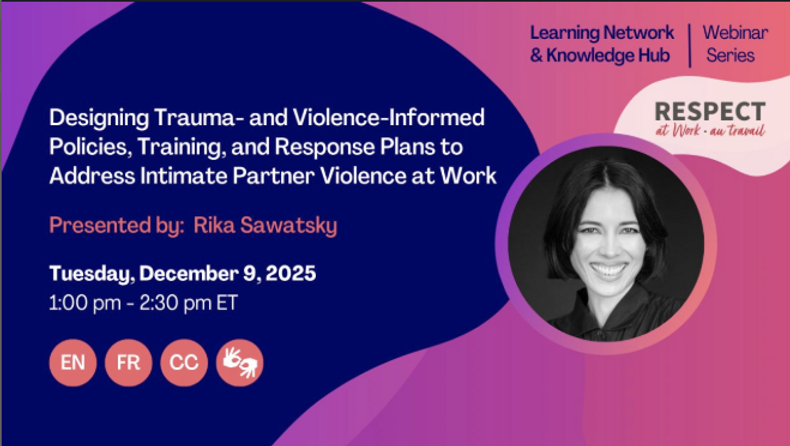
Upcoming Free WebinarDecember 9, 2025 | 1:00–2:30 PM ET
I’m honoured to be presenting an upcoming webinar with the Learning Network and Knowledge Hub, in partnership with the Centre for Research & Education on Violence Against Women & Children (CREVAWC) at Western University.
The session — “Designing Trauma- and Violence-Informed Policies, Training, and Response Plans to Address Intimate Partner Violence at Work” — will explore how a trauma- and violence-informed (TVI) approach can reshape employer responses to employees experiencing intimate partner violence (IPV).
Grounded in a real-life arbitration case, this webinar invites participants to examine how a trauma- and violence-informed (TVI) lens might have changed an employer’s response to an employee experiencing intimate partner violence. The webinar explores what a TVI analysis would have revealed about the survivor’s needs and barriers to participation in the accommodation process. Understanding these dynamics can also further help service providers anticipate potential barriers and more effectively support survivors in navigating workplace responses. Building on these insights, the session will “reverse-engineer” the employer’s legally required workplace violence program to identify policy and procedural measures that could have recognized risks and warning signs of IPV earlier, reduced harm, and strengthened support for survivors.
Learning Objectives: A TVI Approach to IPV at Work
By the end of this webinar, participants will be able to:
- Identify the unique barriers that survivors—including those who are racialized, rural, or otherwise marginalized—face when seeking support for intimate partner violence at work.
- Enhance standard template workplace violence policies to make them more trauma- and violence-informed and survivor-centred.
- Deepen understanding of workplace violence procedures and legislative obligations, and how these shape the experiences of employees experiencing intimate partner violence.
This is a topic that’s deeply personal to me — and one I’ve built much of my legal and consulting practice around.
Why This Matters
Long before I began advising organizations on workplace responses to domestic violence, I experienced intimate partner violence myself. As a young summer student, I faced harassment at work from an abusive partner, but what my colleagues saw was just the tip of the iceberg. Things were so much worse at home. My colleagues didn’t know how to respond — and neither did I.
I share this because it shaped the way I now approach my work. By law, employers must play a critical role in supporting workers who are navigating abuse, and yet so often, they simply don’t know what to look for or what to do.
The statistics are sobering: the Centre for Research & Education on Violence Against Women & Children found that 6.5% of any given workplace is experiencing intimate partner violence on any given day. Other studies place that figure closer to 10%. That means it’s not a rare, “out there” issue — it’s happening in most workplaces, often unnoticed.
A trauma- and violence-informed approach asks us to look deeper — to understand how trauma shows up, to anticipate barriers, and to respond in ways that promote safety, trust, and dignity.
Join the Webinar
December 9, 2025 | 1:00–2:30 PM ETRegister here
There will be a live Q&A session at the end — I’d love to hear your questions and reflections.
Follow Along: 16 Days of Activism
In the lead-up to this webinar, I’ll be sharing a LinkedIn video series for the 16 Days of Activism Against Gender-Based Violence. Each day, I’ll post one practical tip from an employment law perspective — concrete steps that employers, HR professionals, and coworkers can take to better support people experiencing domestic violence.
You can follow along on LinkedIn to join the conversation and access all 16 videos as they’re released.
If you take one thing away: Domestic violence is not just a personal issue — it’s a workplace issue. And with the right tools and understanding, workplaces can be powerful spaces for safety and support.
If you're interested in learning more about how you can implement a domestic violence mitigation and response strategy at your workplace, please reach out. I'd love to speak with you.
.png)
.png)