
← Back to blog
Debunking the Top 5 Myths About Pay Transparency and the Gender Wage Gap
Wage Gap
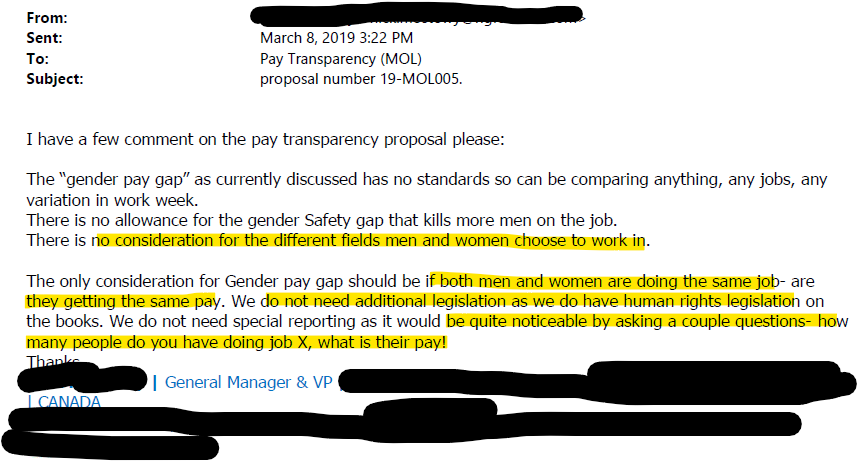
When I received the results of my Freedom of Information and Protection of Privacy Act (FIPPA) request to review employer submissions on the Ford government’s consultation about whether to keep the Wynne government’s Pay Transparency Act, 2018 (spoiler: it was shelved), one theme stood out: many employers fundamentally misunderstand what pay transparency and the gender wage gap are really about.
Here are the top five myths I noticed—and why they don’t hold up.
Myth 1: “Unionized workplaces don’t have a pay gap.”
It’s true that collective agreements often use gender-neutral pay grids. But gaps can still emerge if women and gender-diverse employees have, for example, less access to overtime or opportunities to earn merit increases. The structure might look fair on paper, but the outcomes may tell a different story.
Myth 2: “We already have enough laws to close the gap.”
Employment Standards, the Pay Equity Act, and the Human Rights Code are crucial—but they don’t address one of the biggest drivers of the pay gap: differences within the same occupation. Caregiving responsibilities, for example, can directly impact who gets overtime, promotions, or bonuses.
Myth 3: “Overtime is a choice; it has nothing to do with gender.”
Overtime is rarely a neutral “choice.” Who can accept extra hours is often shaped by caregiving demands. And who gets offered overtime can be influenced by unconscious biases about availability or commitment.
Myth 4: “Bonuses are purely performance-based.”
Performance metrics aren’t immune to bias. Women may have less access to after-hours networking, client dinners, or travel. Racialized employees and people with disabilities also face systemic barriers that can reduce visibility and advancement opportunities.
Even lucrative accounts—the ones that drive higher bonuses—are often funneled to employees who appear more “dedicated” or “partnership material,” which can quietly exclude women and gender-diverse people.
Myth 5: “Commissions are about ambition, motivation, and skill.”
Ambition and skill only matter if employees have equitable access to clients, training, and sales opportunities. If the biggest accounts or peak opportunities consistently go to those who can stay late, travel often, or bond at networking events, then the system itself—not individual ability—is shaping outcomes.
Why Pay Transparency Matters
Even if you’re outside of British Columbia, where pay transparency reporting is now mandatory, it’s worth tracking your own compensation data. You may be surprised to discover that “gender neutral” policies aren’t achieving the outcomes you intended.
With data in hand, you can pinpoint where gaps are happening—and take meaningful action.
As Rita (Jaiya) Parikh of Vancity Community Investment Bank noted in BC's 2025 Pay Transparency Annual Report:
“The results revealed that even in an organization that has woven a commitment to equity into the work we do every day, a pay gap between men, women and non-binary folks still existed. So we took action. The data gathered in our report allowed us to implement new training, reimagine our systems to better address pay gaps, and work on a new compensation philosophy that clearly articulates our commitment to equity and its practical implications.”
The bottom line: Pay transparency isn’t about punishing employers. It’s about surfacing inequities and building compensation systems that are truly fair.
Contact me to discuss what strategies you could pursue to close the gap at your workplace.
.png)
.png)