
← Back to blog
The Employer Duty Nobody Explains: Domestic Violence and OHSA Section 32.0.4
Workplace Domestic Violence
.png)
Ontario employers have had a legal duty to act on domestic violence risk in the workplace since 2010. Most have never been told what it actually requires, and many are waiting for a warning sign that the evidence says may never come.
With renewed attention on the serious "non-physical" forms of intimate partner violence thanks to the Supreme Court of Canada's decision in Ahluwalia, now is a good time to revisit what this provision of the Occupational Health and Safety Act actually means:
32.0.4 If an employer becomes aware, or ought reasonably to be aware, that domestic violence that would likely expose a worker to physical injury may occur in the workplace, the employer shall take every precaution reasonable in the circumstances for the protection of the worker.
The handbook problem
This provision is reproduced in many workplace handbooks without much explanation or training on what to do about it. Which often means employers don't do anything about it.
Employers don't know how to recognize IPV. They don't know how to talk to employees about it. And they don't know how to protect their employees. So this excerpt in their workplace violence policy does nothing at all. I've had clients call asking what to do about a difficult spouse of an employee, focusing on the annoyance that spouse is presenting to the workplace. Only after prodding on my end do they realize that they're actually dealing with a symptom of IPV and that a different response is required.
When is the duty triggered?
The duty in s. 32.0.4 turns on a prediction: that domestic violence "would likely expose a worker to physical injury" at the workplace. So when does an employer cross from "not aware" to "ought reasonably to be aware"? When does risk become likely enough to require action?
The reality is that it's hard to tell when IPV may expose someone to physical injury at work. Many employers assume that a history or threat of physical injury is the best indicator. It isn't. And waiting for prior physical injury at home means you've already missed the opportunity to support your worker, and quite possibly the legal trigger as well.
I wanted to know how the Ministry of Labour's own inspectors assess this, so I filed a freedom of information request. The answer: there is no guidance on the trigger at all.
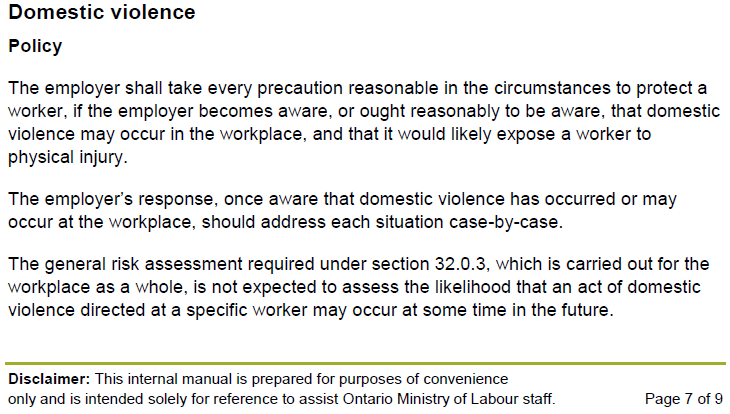
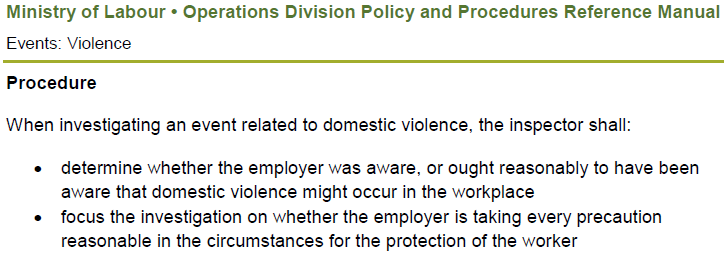
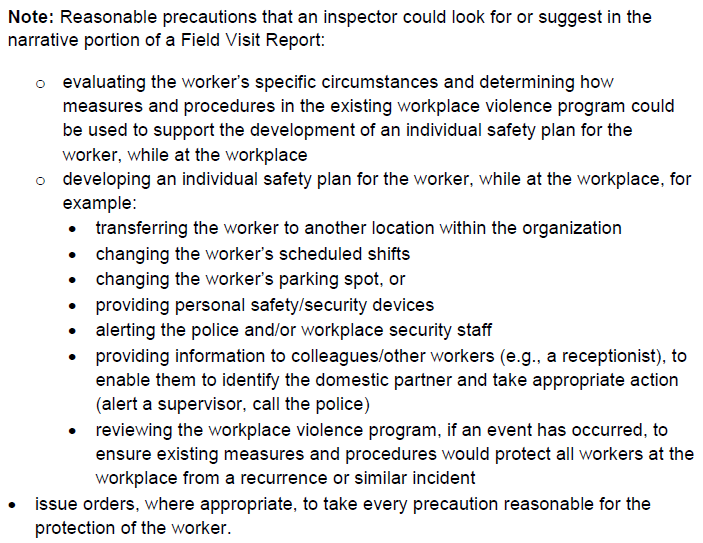
The Ministry of Labour has not equipped its inspectors with any framework for deciding when the duty is engaged. So how are employers supposed to know any better?
What the homicide data tells us about risk
Learning from past intimate partner homicides, we do know some of the risk factors for lethal violence. They're documented in the annual reports of Ontario's Domestic Violence Death Review Committee (DVDRC) [link]. And when you look at them, you'll notice that many do not involve prior physical injury.
The top five risk factors:
- History of IPV, which includes "non-physical" forms of coercive control
- Actual or pending separation
- Perpetrator depression
- Obsessive behaviour displayed by the perpetrator
- Excessive alcohol or drug use by the perpetrator
A worker who has recently separated from a partner with a history of coercive control, and no history of physical violence, sits squarely within the documented risk profile for lethal violence. An employer waiting for evidence of a past assault before acting is calibrating to the wrong signal.
What this means for employers: act on awareness, not on injury
Considering the fair, large, and liberal interpretation we're required to take of health and safety legislation, employers should arguably start taking precautions for the protection of workers as soon as they learn of IPV of any form. Learning to recognize coercive control is a critical part of this.
What the precautions look like will depend on a risk assessment and safety planning engaged in with the survivor. Domestic violence safety planning done to a worker rather than with her can increase danger rather than reduce it, and it misses the information only she has.
In practice, reasonable precautions sit on a spectrum, and most are affordable and easy to implement. They can include adjusting a worker's schedule, location, or shift visibility; changing a phone extension or email address; screening calls; arranging escorted access to parking; briefing reception or security on who should not be admitted; reviewing what the organization publishes about where and when she works; and connecting her with entitlements she may not know she has, including Ontario's domestic violence leave, which does not require proof of abuse. The right combination comes out of the risk assessment, not a template.
Two boundaries keep this lawful and safe. First, the how should be survivor-led wherever possible: she knows her partner's patterns, what will escalate him, and what will expose her, and precautions imposed over her objection can increase danger rather than reduce it. Second, the duty itself belongs to the employer and cannot be outsourced to the worker. If she declines to participate, the employer is not relieved of its OHSA obligations; it must still assess and mitigate the risk to her and to other workers, using the least intrusive measures available and protecting her privacy while it does.
If you're trying to figure out when your organization's duty is triggered and what it requires in practice, that's exactly the question I help employers work through. Start with the free Workplace IPV Readiness Diagnostic, or get in touch about a readiness alignment session.
%20(2).png)
.png)