
← Back to blog
Intimate Partner Homicide at Work
Workplace Domestic Violence
.png)
On March 26, in my other home country of Japan, a 21-year-old woman was murdered by her ex at work. Taiki Hirokawa killed Moe (Mo-é) Harukawa at a Pokémon Center in Tokyo, attacking her behind the till with a knife. He alternated between stabbing her and himself in the neck until they died.
Before dismissing this as a tragedy that happened somewhere else, please consider this.
This Happens Here Too: Risk Factors for Domestic Homicide in Canada
Hirokawa quickly became controlling in their relationship, including pressuring Harukawa not to work. This kind of control happens in Canada.
She left him because of his controlling behaviour. He then started stalking her. Stalking and escalating danger after separation happen in Canada.
Harukawa reported the stalking to police, leading to Hirokawa’s arrest. He was released with a no-contact order and a recommendation to seek counselling. Catch-and-release happens in Canada.
History of IPV, including coercive control, is the #1 risk factor for domestic homicide in Canada.
Recent separation is the #2 risk factor for domestic homicide in Canada.
Stalking is the #3 risk factor for domestic homicide in Canada.
Perpetrator unemployment is the #6 risk factor for domestic homicide in Canada.
Perpetrator suicidality is the #9 risk factor for domestic homicide in Canada.
Ontario’s Occupational Health and Safety Act's (OHSA) workplace IPV provisions resulted from Lori Dupont’s murder by her ex-partner at work in Canada.
The Workplace Question Is Missing
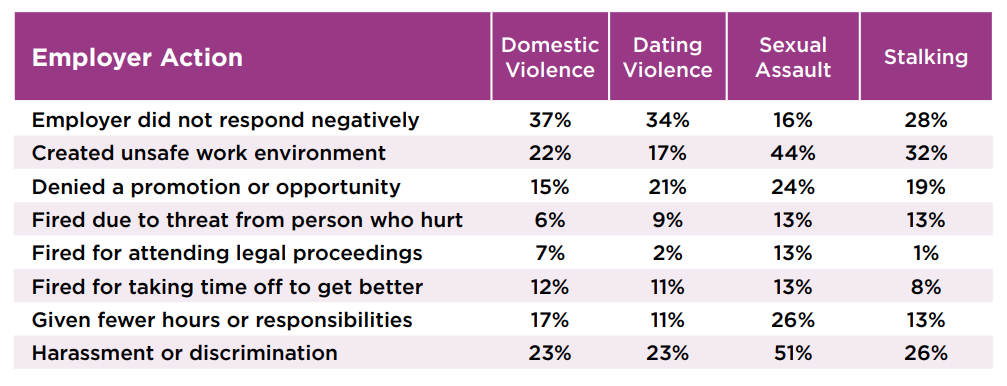
There’s no discussion in the news of what the employer could have done here. Harukawa may not have sought her employer’s support for fear of retaliation. That fear is backed up by data here, too, with the majority of survivors reporting negative blowback after disclosing to their employers.
Employers Have a Duty to Address Workplace Intimate Partner Violence
Employers have a legal duty to protect workers from IPV because it follows survivors into every domain of life, including their workplaces. Section 32.0.4 of OHSA states:
Domestic violence
32.0.4 If an employer becomes aware, or ought reasonably to be aware, that domestic violence that would likely expose a worker to physical injury may occur in the workplace, the employer shall take every precaution reasonable in the circumstances for the protection of the worker.
Similar workplace domestic violence provisions exist in other jurisdictions.
If we’re going to protect workers from IPV at work, the very first step is making it safe enough to disclose. It’s not enough to have something in a policy somewhere. We need to acknowledge that it’s happening. We need to normalize talking about it. Our managers need to learn how to handle these conversations, and to keep the conversation going rather than shutting it down. And from there, we can implement the more technical pieces, like referral pathways, safety planning, risk assessments, and decision trees.
But the very first step really is creating a safe space for disclosure.
A Beating Is Not a Prerequisite to Femicide
One more critical point: Harukawa dated Hirokawa for only a few months. And there was never any physical violence until her murder. A beating is not a prerequisite to femicide. We need to take the other signs of risk escalation very seriously, and it is critical that managers learn these signs as part of their broader workplace violence programming.
When OHSA says that the employer’s duty to act is triggered by a risk of physical violence (see excerpt above), it is unequivocally a mistake to look for past physical violence as a condition to act.
Getting Started With a Workplace IPV Program
Getting started is easy, and cost-free. You can find many excellent workplace domestic violence resources at dvatwork.ca, prepared by the Centre for Research and Education on Violence Against Women and Children, the Canadian Labour Congress, and FETCO.
The only missing piece on that site is the legal analysis. To fill that gap, I’ve separately prepared a free resource helping employers self-assess their understanding of the relevant legal principles. The guide also contains a self-assessment for providing trauma- and violence-informed support, as well as a roadmap to setting up your workplace IPV program.
Next Steps for Employers
If your organization needs further support, I can help.
I offer fixed-fee assessments of existing workplace IPV programs, manager training on handling disclosures, guidance on workplace risk assessments and safety planning, and support building a fully fledged trauma- and violence-informed workplace domestic violence program, including decision trees, referral pathways, and practical response tools.
Please remember that Moe Harukawa isn’t someone else. She’s among our colleagues.
.png)
.png)